

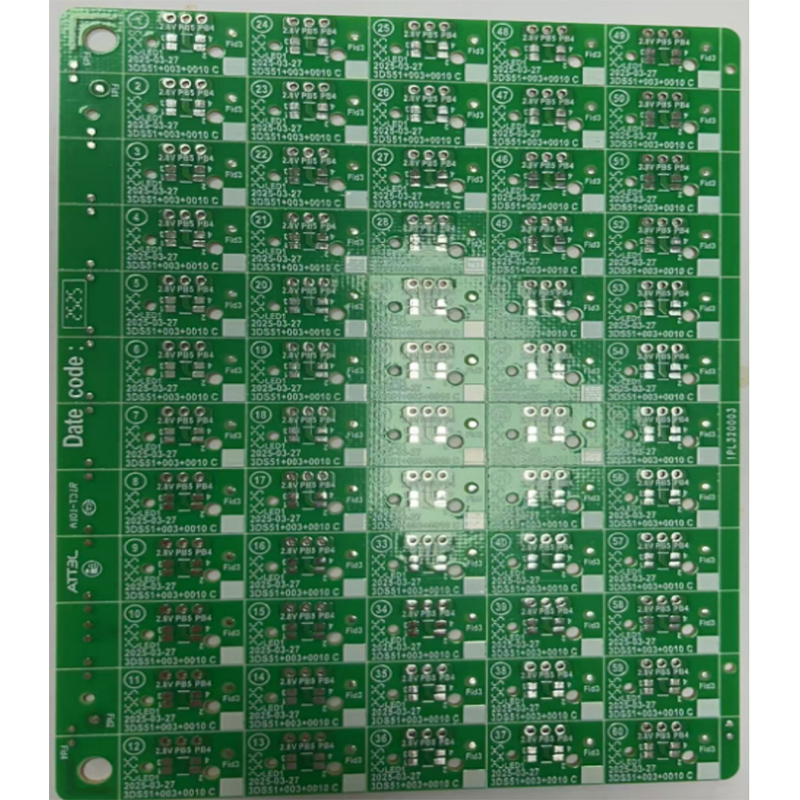
Product Overview
This product is a single-sided printed circuit board with tin-sprayed surface treatment, designed for reliable solderability, efficient heat dissipation, and cost-effective electronic manufacturing.
The tin-sprayed layer provides a uniform protective coating that improves surface conductivity and prevents oxidation of the copper pads during assembly and storage.
Key Features
Single-sided circuit design: Simple structure, stable performance, and easy manufacturing
Tin-sprayed surface finish: Enhances solderability and protects against oxidation
Excellent thermal performance: Suitable for heat-generating electronic components
Good electrical conductivity: Stable and reliable signal transmission
Strong adhesion layer: Ensures durable coating performance
Cost-effective solution: Ideal for high-volume production and budget-sensitive applications
Technical Specifications
Board type: Single-sided PCB
Base material: FR-4 / aluminum-based substrate (optional depending on application)
Surface finish: Tin spraying (Sn coating)
Tin thickness: 5–30 μm (customizable)
Copper thickness: 1 oz / 2 oz (customizable)
Board thickness: 0.8 mm – 2.0 mm (typical range)
Minimum line width/spacing: 5/5 mil (depending on manufacturing capability)
Operating temperature: -40°C to 120°C (standard FR-4 version)
Applications
LED lighting modules and driver boards
Consumer electronics
Power supply units
Small household appliances
Industrial control systems
Automotive auxiliary electronics
Advantages
Compared with untreated or bare copper boards, tin-sprayed single-sided PCBs offer:
Improved solderability for assembly processes
Better oxidation resistance during storage and transport
More stable surface condition for mass production
Cost-efficient alternative to ENIG or OSP finishes
Reliable performance for low to medium complexity circuits
Customization Options
Base material selection (FR-4 or aluminum-based)
Tin thickness adjustment
Copper weight customization
Board size and thickness
Surface finish combination options (selective tin spraying)
Solder mask color options
Quality Assurance
Each board is strictly tested to ensure consistent quality:
Electrical continuity and insulation testing (E-test)
Surface coating uniformity inspection
Solderability testing
Dimensional accuracy control
AOI (Automated Optical Inspection)
Cross-section quality verification (if required)